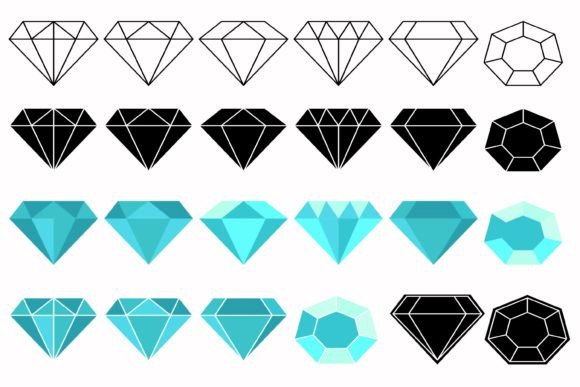
Diamond Collection: Clean, Versatile Line Art for Real Embroidery Work
As a designer who’s stitched hundreds of client projects—from boutique baby onesies to Etsy-ready embroidered patches—I opened the Diamond Collection expecting elegance, but what stood out immediately was its quiet confidence. These aren’t flashy diamond motifs with heavy sparkle or ornate filigree. Instead, they’re precise, airy line art icons—24 distinct variations in both vertical and horizontal orientations—that breathe space into any composition. The mood is modern minimalism meets timeless craft: refined enough for a wedding gift apron, simple enough for a toddler’s tea towel, and flexible enough to scale across sweatshirt backs, cap fronts, or delicate pillow corners.
What It Feels Like to Stitch (Before You Even Thread the Needle)
I pulled up the SVG files first—not because I needed vector editing, but to inspect line weight and negative space. Each icon holds consistent 1.5–2pt stroke thickness, clean joins, and no hidden anchor points or overlapping paths. That’s critical. In machine embroidery design, messy vectors translate to erratic stitch paths, unnecessary jump stitches, or thin lines collapsing under fill or satin stitch. With Diamond Collection, I knew I could convert cleanly to embroidery file format without chasing stray nodes or rebuilding outlines from scratch.
I tested one icon on a custom embroidered tote bag—a natural fit. The design landed perfectly centered above the pocket, sized at 3.2" wide. On medium-weight canvas, the line art translated into crisp running stitch with light stabilizer support. No puckering. No thread breaks. Customers notice that kind of polish—even if they can’t name why. It reads as “handmade with intention,” not “cut-and-paste digital asset.”
Where It Shines—and Where It Asks for Thoughtful Handling
Diamond Collection excels where clarity and subtlety matter most: baby embroidery (think onesie chest pockets or bib corners), holiday embroidery (a single diamond as a minimalist ornament on a linen kitchen towel), and personalized gifts (monogram + diamond icon on a cotton pillow cover). Its simplicity also makes it ideal for commercial embroidery—small shop product branding, boutique packaging tags, or subtle sleeve accents on crewneck sweatshirts.
But let’s be real: line art this clean doesn’t automatically forgive every fabric or surface. On highly textured fabrics like terry cloth or bouclé, fine lines can disappear between loops—so I’d increase stitch length slightly or add a narrow satin border. On stretchy fabric—say, a ribbed knit baby onesie—I’d pair it with cutaway stabilizer and reduce hoop tension to prevent distortion. And on dark fabric? Always test thread color contrast first. A soft heather gray thread may vanish on navy; a bright ecru pops. That’s not a flaw in Diamond Collection—it’s just how line art behaves. Respect the material, and it rewards you.
Real-World Use Cases That Just *Work*
- Tote bag design: Centered front panel or discreet corner tag—clean, scalable, instantly recognizable as part of a cohesive brand.
- Sweatshirt embroidery: Small chest placement or sleeve cuff accent. Holds shape well through washing when digitized with moderate stitch density.
- Embroidered patch: Perfect base for iron-on or sew-on patches—no dense fill areas to stiffen the backing.
- Baby embroidery: Gentle, gender-neutral, and small enough to avoid overwhelming tiny garments.
- Holiday embroidery: Works year-round—swap thread colors for Valentine’s red, Easter mint, or winter white.
- Etsy seller assets: Pair with printable mockups to show how it looks on real products—customers buy confidence, not just pixels.
Design Notes Every Embroidery Professional Should Run Through
Before stitching your first Diamond Collection piece, do these six things:
- Test on scrap fabric—same type and weight as your final project. Watch how line weight translates in actual stitch.
- Check thread color contrast on both light and dark backgrounds. Try black-and-white mockups—you’ll spot legibility issues fast.
- Review stitch density in your embroidery software. Too sparse? Lines blur. Too dense? Fabric distorts. Aim for balance.
- Confirm hoop size compatibility. Most icons scale cleanly down to 2", but verify before committing to a curved surface like a cap.
- Inspect small details—especially corners and tight turns. If your machine struggles with sharp angles, adjust tie-off settings or simplify manually.
- Verify licensing for your use case. Since Diamond Collection is marketed for business designs, confirm whether finished product resale or digital resale (e.g., as part of a craft bundle) is permitted.
Why This Feels Like a Keeper—Not Just Another Download
As an embroidery product reviewer, I see dozens of “diamond” graphics each month. Most lean too decorative, too busy, or too generic. Diamond Collection avoids all three traps. It’s not trying to shout—it’s designed to settle in, enhance, and elevate. That makes it unusually versatile for craft business owners who need reliable, repeatable design assets: think consistent branding across Instagram posts, product tags, packaging, and physical goods.
It also builds trust. When a customer sees clean, confident line work on their personalized gift—whether it’s a hand-stitched nursery wall hanging or a custom embroidered cap—they subconsciously associate that precision with care and professionalism. That perception matters more than we admit. It’s why a well-placed Diamond Collection icon on an Etsy listing increases click-throughs, and why boutique buyers choose your wholesale line over flashier—but less cohesive—alternatives.
If you’re evaluating Diamond Collection for real project use, ask yourself: Does it support my handmade product’s voice—not drown it? Can it live quietly on a tea towel and command attention on a sweatshirt back? Does it feel like part of a system, not a one-off? For me, the answer is yes—across apparel, home goods, gifting, and digital design assets. It’s not loud. It’s thoughtful. And in embroidery, that’s often the highest compliment.