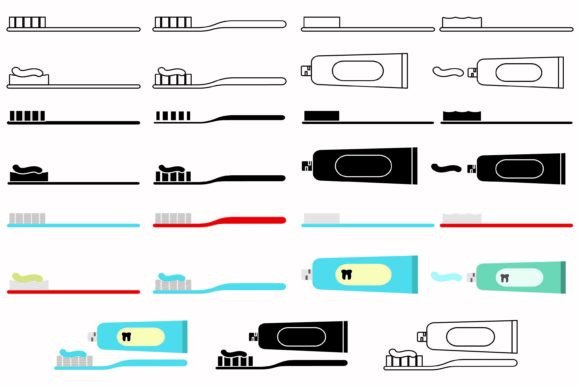
Oral Hygiene Toothbrush and Toothpaste
A Designer’s First Look: Clean, Friendly, and Surprisingly Versatile
When I opened the Oral Hygiene Toothbrush and Toothpaste set, I wasn’t expecting to pause mid-scroll—but I did. These aren’t cartoonish or overly clinical; they’re confident line art icons with gentle curves, balanced negative space, and a quiet sense of warmth. The toothbrush leans slightly, the toothpaste tube has just enough taper and cap detail, and both feel intentional—not rushed or generic. As a designer who regularly selects embroidery files for client work and my own craft business, that first impression matters: it tells me whether this will translate well into stitch, hold up in real-world wear, and resonate with customers who appreciate thoughtful handmade detail.
Where It Shines: Real Projects That Feel Like a Natural Fit
I recently prepped a small-batch run of embroidered cotton tote bags for a local dental hygienist’s office—part gift, part branded swag. I tested Oral Hygiene Toothbrush and Toothpaste as a single vertical icon centered on the front pocket. On natural canvas, stitched in soft mint and charcoal thread with a light tear-away stabilizer, it read clearly at 3.2 inches tall. No bleeding, no skipped details—even the subtle curve of the brush handle stayed crisp. It also worked beautifully on a baby onesie (using a lightweight cut-away stabilizer), where parents appreciated the gentle, non-cutesy aesthetic. I’ve since used one of the horizontal variants on a linen tea towel for a boutique kitchen line—it paired perfectly with minimalist typography and held up after three test washes without fraying or puckering.
Why It Works for Embroidery (and Why Some Files Don’t)
- Line weight consistency: The strokes are uniform—no sudden thins or flares—so satin stitch edges stay smooth and running stitch outlines remain legible even at smaller sizes.
- No micro-detail traps: No tiny text, ultra-thin connectors, or overlapping layers that collapse under dense fill stitch. That means fewer re-hooping moments and less risk of thread breaks on commercial machines.
- Negative space is generous: Critical for breathable fabric like knits or lightweight cotton—stitch density stays manageable, and the design doesn’t overwhelm the base material.
- SVG + PNG flexibility: As a Web Elements asset, the clean vector files let me scale confidently for embroidery digitizing (or for printable mockups when listing on Etsy), while the 300dpi PNGs help clients visualize color palettes before stitching begins.
Where to Use It Thoughtfully—Not Everywhere
This isn’t a one-size-fits-all embroidery file—and that’s a good thing. Its strength is clarity, not complexity. So before committing to a project, I ask myself: “Does this surface support clean lines?” Here’s where I proceed with care:
- Stretchy fabrics (like jersey or ribbed knit): The design holds up, but only with proper cut-away stabilizer and reduced stitch density—otherwise, the lines can blur or distort.
- Dark or textured fabrics (corduroy, heavy terry, fleece): The line art reads best with high-contrast thread (e.g., white on navy), but avoid placing fine details over deep grooves—they’ll disappear in the pile.
- Caps and curved surfaces: The vertical versions work better than horizontal here—less distortion across the crown. Always test hoop placement on an actual cap blank first.
- Patches and layered appliqué: It’s ideal for simple iron-on patches, but avoid pairing it with dense border stitches unless you’ve confirmed the overall stitch count won’t stiffen the finished product.
- Frequent-wash items (baby bibs, kids’ towels): Stick to quality polyester thread and secure backing—those clean lines need durability to stay sharp over time.
What It Adds Beyond Stitching—Trust, Tone, and Quiet Professionalism
As an Etsy seller and custom apparel designer, I’ve learned that buyers don’t just buy embroidery—they buy *feeling*. Oral Hygiene Toothbrush and Toothpaste delivers calm competence. It signals care without being clinical, playfulness without silliness. When stitched onto a nurse’s scrub cap or a pediatric dentist’s waiting room pillow cover, it feels respectful—not gimmicky. For handmade product listings, it elevates perceived value: clean line art reads as intentional, curated, and professionally sourced. And because it’s part of a 27-icon set, it supports cohesive branding across products (e.g., matching toothbrush + floss + mouthwash icons on a wellness-themed gift set).
Practical Notes Every Embroidery Designer Should Check
Before digitizing or stitching:
- Test the design on scrap fabric matching your final project’s weight and stretch.
- Check thread color contrast early—especially if using light thread on dark fabric or vice versa.
- Review stitch density in your embroidery software: aim for 8–12 stitches/mm in satin areas, and avoid stacking more than two layers of fill stitch in tight zones.
- Confirm hoop size compatibility—some vertical icons may require a 4×4 hoop minimum; horizontal layouts often fit comfortably in 3×3.
- Inspect corners and endpoints: line art can show “jogs” if anchor points aren’t optimized for stitch direction.
- Run black-and-white mockups—this reveals clarity issues invisible in color previews.
- Verify licensing: since it’s labeled for business use, confirm whether resale of finished embroidered items is permitted (most Graphics assets allow this, but always double-check).
Final Thought: A Quietly Confident Design Choice
Oral Hygiene Toothbrush and Toothpaste won’t shout—but it doesn’t need to. In a market flooded with busy, over-digitized motifs, its restraint is its strength. It works because it’s designed *for* real use: on fabric, under thread, in hands, and in homes. Whether you’re stitching a personalized baby blanket, building a dental practice’s branded merchandise line, or creating digital embroidery files for other makers, this set earns its place—not as filler, but as a reliable, human-scaled detail that quietly says, “I paid attention.” And in handmade work, that’s everything.